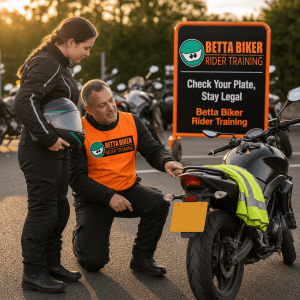
UK law requires every motorcycle to display a rear number plate that's clearly legible, correctly sized, properly lit at night, and unobstructed by mudguards, luggage, or exhaust smoke. Motorcycles only need a rear plate, not a front one. Get the format, size, or fixing wrong and you're risking a fine, points, or an MOT failure.
Do motorcycles need a front number plate?
No. Unlike cars, motorcycles registered in the UK only need to display a number plate on the rear. This applies to scooters, geared bikes, and mopeds alike. If you're used to cars, this trips a lot of new riders up when they're checking their bike over before a test or a ride out, so don't go looking for a front plate bracket that isn't supposed to be there.
What size and format must the plate follow?
Motorcycle plates use different dimensions to car plates because they're mounted in a smaller space. The registration must be displayed in the correct font (the standard Charles Wright typeface used across the UK), with the correct spacing between characters and groups. You can't stretch, squash, or reposition the characters to make a plate look "sportier" or to fit a tighter tail unit. Number plate suppliers producing plates for road use have to follow the British Standard for reflective plates, and any plate you buy for road use should confirm it meets that standard.
Plates that use unofficial fonts, italicised characters, or non-standard spacing are illegal to use on the road, even if they were sold to you as "show plates" or "display only." If a plate looks unusual, ask before you fit it.
Can I get a private or personalised plate for my motorcycle?
Yes. Motorcycles can carry personalised registrations the same as any other vehicle, as long as the plate still meets the legal format requirements above. A private plate doesn't give you licence to bend the font, spacing, or size rules. It just changes the combination of letters and numbers, not the presentation.
What are the lighting and visibility rules?
Your number plate has to be lit so it's readable at night, which is why every motorcycle has a small number plate light built into the rear light cluster. If that bulb's blown, your plate isn't legally displayed after dark, even if the plate itself is fine. It's worth checking this alongside your brake light and indicators when you do a walkaround before a ride.
The plate also needs to be kept clean and free from obstruction. Mud, a dragging mudguard, an oversized exhaust can, or a poorly positioned pannier or tail bag can all obscure the plate enough to cause a problem. Number plate angle matters too. It should sit close to vertical, not angled sharply down or to the side to "tuck it in," which is a common styling choice on modified bikes that often falls foul of the rules.
What happens if my number plate isn't compliant?
A non-compliant plate (wrong font, wrong size, poor lighting, obscured, or fitted at the wrong angle) can result in a fixed penalty notice, points on your licence, or an MOT failure once your bike is old enough to require one. Police can also stop you and ask you to correct the issue immediately. None of this is complicated to avoid: it comes down to buying a plate from a legitimate supplier and checking it regularly, the same way you'd check your tyres or your chain.
Why does this matter more for new riders?
If you're working towards your CBT or a full licence, you might not own your own bike yet, but the plate rules still matter because they're part of understanding what "roadworthy and legal" actually means. Examiners and instructors expect you to know the basics of what makes a bike legal to ride, not just how to operate the controls. It's the same mindset we build into our CBT courses at Betta Biker: we're not just teaching you to balance and change gear, we're developing what we call "thinking" riders, people who understand the reasoning behind the rules rather than just following them by rote.
Common questions about motorcycle number plates
Do I need a front number plate on my motorbike?
No. UK motorcycles only require a rear number plate. This is different from cars, which need one at the front and back.
Can I fit a show plate to my motorcycle for road use?
No. Show plates and novelty plates that don't follow the standard font, spacing, and size rules are illegal for road use, regardless of how they're marketed when sold.
Will a dirty or obscured plate fail my MOT?
Yes. A plate that's illegible due to dirt, damage, poor lighting, or obstruction from mudguards or luggage can cause an MOT failure and can also result in a roadside penalty.
Does a personalised plate need to follow the same rules as a standard one?
Yes. Personalised or private registrations still have to use the correct font, spacing, and size. Only the character combination changes.
Get properly trained before you worry about the details
Knowing your number plate rules is useful, but it's one small piece of what makes someone a safe, legal rider. If you're just starting out, our CBT courses at Weaverham, Thatto Heath, Tatton Dale, and Newburgh cover the practical riding skills and the legal knowledge you need in one day, for £190, with small group sizes and all bikes and kit provided. Whether you're 16 and starting on a 49cc, 17 and moving to a 125cc, or working towards your full licence with a DAS course, our instructors, led by Chief Instructor Nic Garner, focus on building riders who understand the "why" behind the rules, not just the motions.
Head to www.bettabiker.co.uk to check course dates and book your CBT, or give us a call on 07539 828073 to talk through which course fits where you're at.