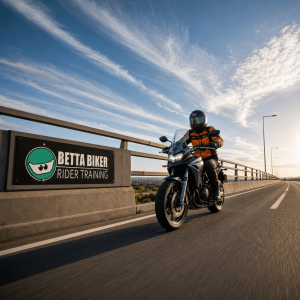
There's a particular feeling every rider knows. You're cruising along a dual carriageway or crossing an exposed bridge, and without warning the bike gets shoved sideways. Your heart rate spikes, your grip tightens, and for a split second everything feels uncertain. Crosswinds are one of those hazards that don't get nearly enough attention in everyday riding conversation, yet they catch people out constantly, especially here in the North West where exposed roads, motorway bridges, and open farmland stretches can turn a straightforward ride into a white-knuckle experience.
Understanding what's happening and knowing how to respond makes all the difference. This isn't about being fearless; it's about being prepared.
Why Crosswinds Catch Riders Off Guard
Unlike car drivers, motorcyclists have almost no shell protecting them from lateral air pressure. Your body and the bike together act as a large sail, and when a strong gust hits from the side, you feel the full force of it. The problem is compounded by gusts that arrive suddenly and unpredictably, particularly when you emerge from a cutting, pass a gap in a hedgerow, or overtake a large lorry.
The lorry scenario is worth highlighting on its own. When you ride alongside a heavy goods vehicle, you enter a bubble of disturbed air. The moment you pass the front of that lorry, you can get hit by a significant crosswind that the vehicle was blocking. Many riders are caught completely off guard by this because the change happens in under a second.
Reading the Environment Before It Reads You
Good crosswind management starts well before the gust arrives. Anticipation is your primary tool. When you're approaching exposed sections of road, bridges, gaps in tree lines, or the crest of a hill, start thinking about wind conditions before you get there.
Check flags, smoke, trees, and even puddles rippling in fields beside the road. If everything is indicating wind from the right, position yourself slightly to the right of your lane. This gives you space to drift left without crossing into oncoming traffic or mounting the kerb. You're essentially creating a buffer zone in the direction the wind will push you.
Speed management matters here too. The faster you're travelling, the greater the aerodynamic forces involved. Slowing down slightly when approaching known exposure points reduces the impact of gusts and gives you more time to react.
The Countersteering Response
When a crosswind hits, the instinct for many riders (especially those newer to biking) is to fight the bike and wrestle it back upright. That's often the wrong move.
A motorcycle is a self-correcting machine when you let it work. At speed, leaning into the wind slightly before the gust arrives allows the bike to find its own equilibrium. Experienced riders often describe this as "pre-leaning" or "crabbing" into the wind. You're essentially angling the bike so that when the gust pushes, you return to upright rather than getting knocked further over.
This connects directly to countersteering, the technique where you push forward on the handlebar on the side you want to lean towards. A gentle forward push on the right bar leans the bike right. Done smoothly and with measured force, this lets you make precise lean adjustments without destabilising the chassis.
The key word throughout all of this is smooth. Sudden, jerky inputs when dealing with crosswinds tend to make things worse. Relax your arms, keep a firm but not rigid grip, and let the bike do some of the work.
Body Position and Grip
Your body is part of the aerodynamic equation. Tucking in slightly and lowering your profile reduces the surface area exposed to the wind. Some riders shift their weight slightly into the wind direction, planting their inside knee against the tank for extra stability.
Avoid the temptation to tense up completely. Tense arms transfer every gust directly into the handlebars, amplifying the instability. Think of your arms as shock absorbers; they should flex and absorb rather than transmit.
Throttle control also plays a role. Maintaining a steady throttle keeps the bike's drive consistent and the chassis settled. Backing off the throttle sharply mid-corner or mid-gust can unsettle the rear, which is the last thing you want when you're already managing lateral forces.
Overtaking and High-Sided Vehicles
As we mentioned, passing lorries and high-sided vehicles requires specific preparation. Before you begin the overtake, check the conditions ahead. If you can see flags or trees suggesting a strong crosswind from the left on an exposed stretch, think carefully about whether the overtake is worth it at that moment.
When you do overtake, accelerate through the manoeuvre rather than loitering alongside the vehicle. The longer you spend in the turbulent air beside a lorry, the longer you're exposed to unpredictable gusts. Complete the overtake decisively and move back to a safe position ahead of the vehicle promptly.
Building These Skills from the Ground Up
None of this is instinctive. These responses need to be practised and understood before you find yourself in the situation. That's why the mental side of riding matters just as much as the physical mechanics.
We've been training riders across the North West since 2015, and our whole approach is built around developing thinking riders rather than just riders who can operate the controls. Chief Instructor Nic Garner has been riding since 1976, and the situations he's navigated over five decades of experience shape how we teach every aspect of hazard awareness, including wind management.
Whether you're just starting out with your CBT or you're looking to progress to a full licence through our DAS course, understanding how your bike behaves in challenging conditions is part of becoming a genuinely capable and confident rider.
If you're ready to start your riding journey or take the next step in your licence progression, visit www.bettabiker.co.uk to find out more about our courses or give us a call on 07539 828073 to have a chat about which route is right for you. Our CBT courses are available at weekends and bank holidays, everything is provided, and we keep group sizes small so you get proper, individual attention from day one.
Gusty conditions will always be part of riding in the UK. The difference between a rider who handles them with confidence and one who gets caught out is knowledge, practice, and the right foundations built early.